
Closet Organizers · Burlington
Closet organizers that give each category a place
Choose hanging, shelves, drawers and useful accessories around the things you store. A practical organizer makes everyday items easier to reach while leaving room for the closet to change.
Consider these configuration choices
- Hanging and shelf divisions
- Drawers and accessories
- Access for everyday items
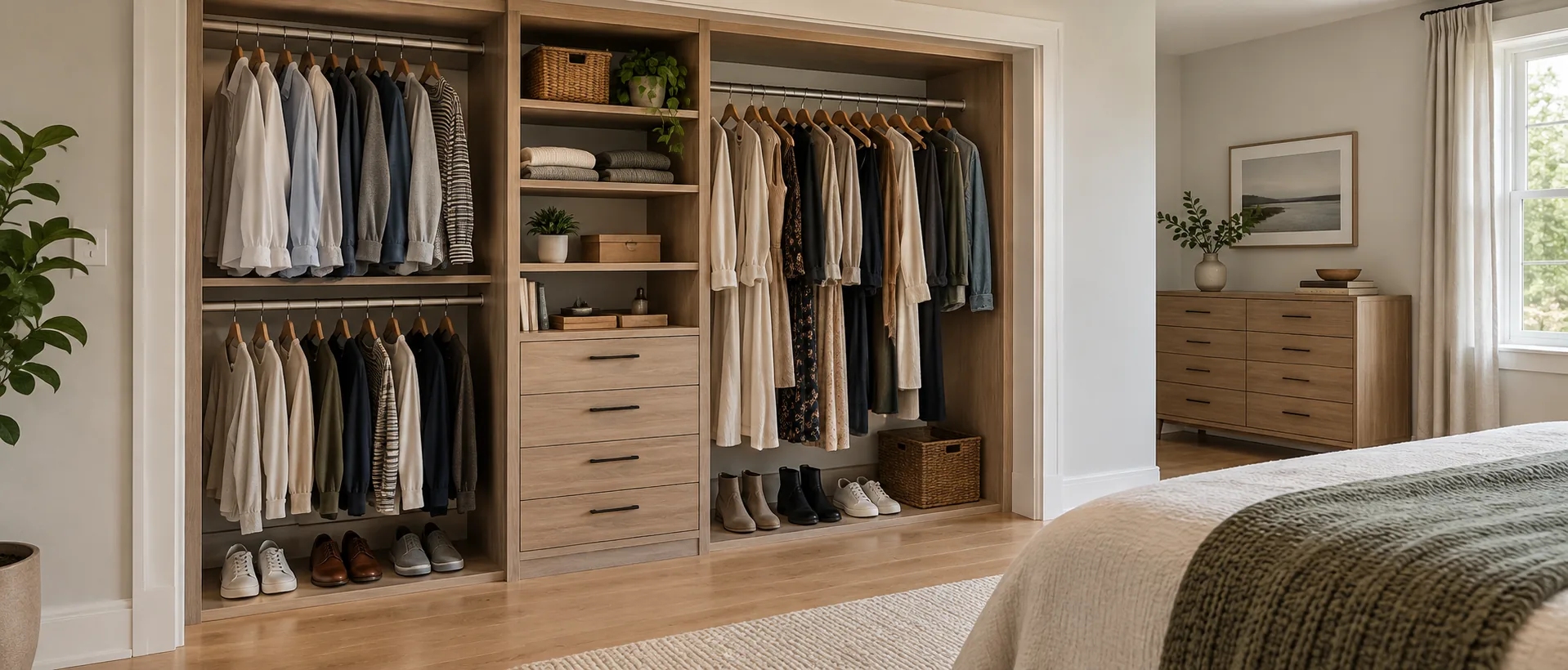
Tell us what the current closet makes difficult
Describe the existing interior and the categories that are difficult to store. Mention shelves you cannot reach, shoes stacked behind other shoes or drawers that have become mixed overflow. Include the open doorway so a proposed organizer can be checked against the space available to use it.
Choose the organizer from the belongings
An organizer is useful when its compartments match what you put away. Start with the closet at its fullest ordinary point, including clothing in the laundry and seasonal pieces kept elsewhere. Separate short hanging, long garments, folded clothing, shoes, accessories and bulky items. Record the categories that are crowded and those occupying more space than they need.
Notice the action that causes the problem. A sweater pile may need a shallower shelf or a drawer, while shirts squeezed onto one rod may need a different allocation of hanging. Buying more fittings before understanding that routine can reduce the remaining useful space. A simple combination, properly placed, is often easier to maintain than a crowded interior filled with specialized accessories.
Where the whole arrangement needs to change, custom closet systems considers the structure and allocation together. Organizer work can also concentrate on selected components within an existing layout.
Use shelf spacing to keep categories visible
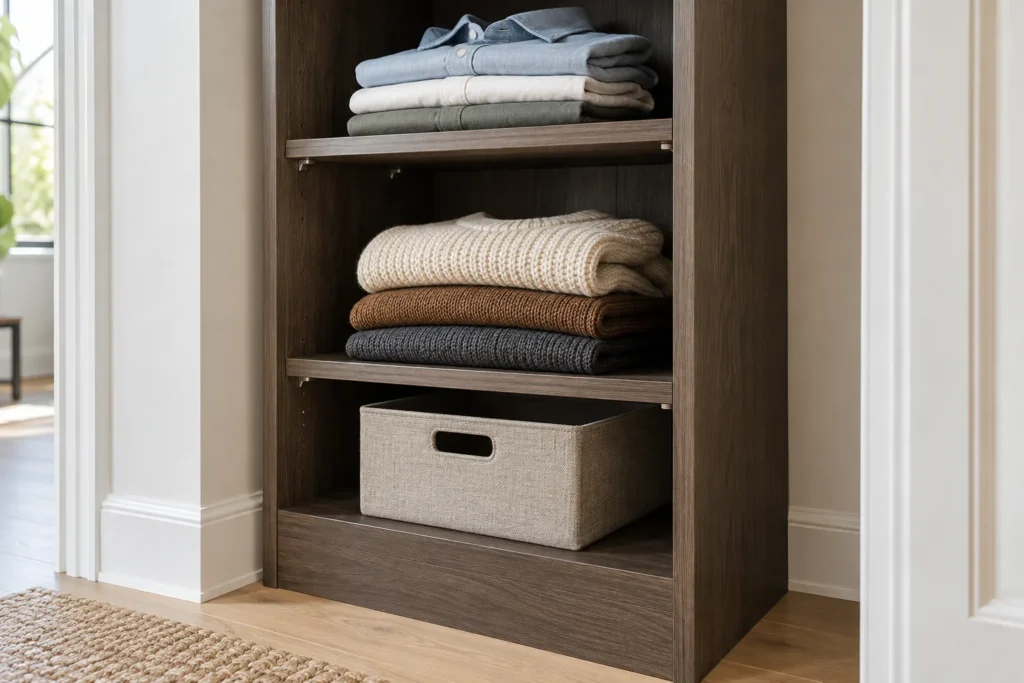
Folded storage works best when the depth and vertical spacing suit the contents. Wide, tall gaps can encourage several unstable piles; tightly spaced shelves may force thick sweaters or towels into compressed stacks. Separate the categories first and use deliberately different openings where their bulk differs.
Adjustable shelves allow that arrangement to evolve, within the support positions and the cabinet’s intended use. Confirm which shelves can move and which provide permanent structure. Shelf depth also matters: adding height does not make a deep back row easier to retrieve. Keep frequently used stacks near the front and resist filling hidden space simply because it exists.
A heavier bin should have a practical lifting position. Upper storage may suit light seasonal items, but the most accessible shelf belongs to the category used every day. Ask how the chosen materials and supports suit the proposed contents rather than relying on an unsupported universal load claim.
Give small items a contained place
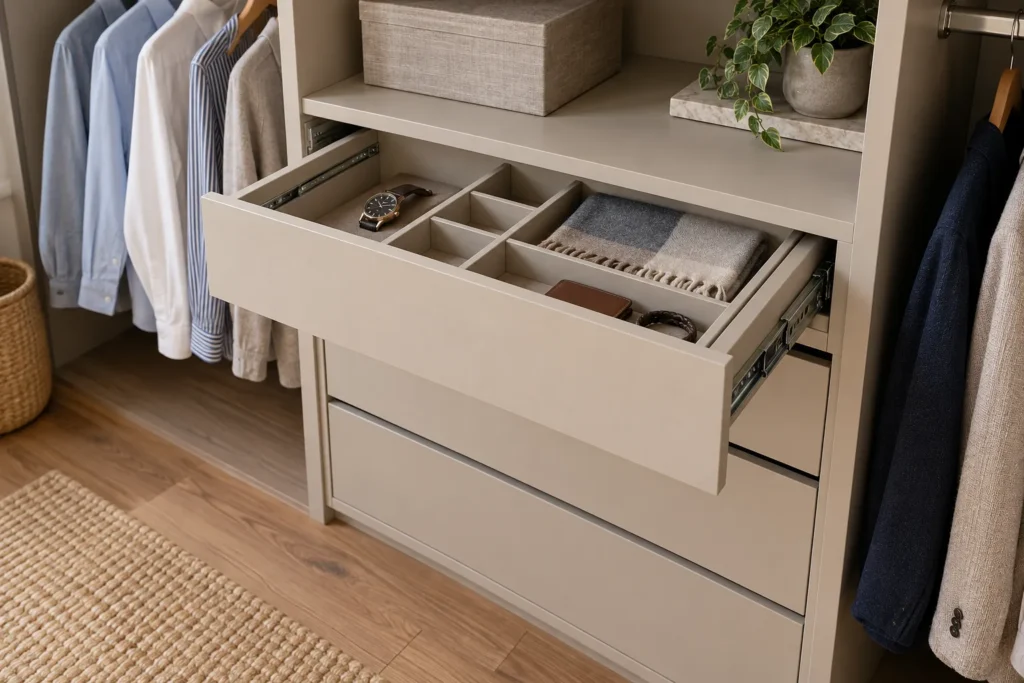
Drawers can gather socks, belts, scarves and loose accessories that otherwise spread across open shelves. Shallow drawers suit items best seen from above; deeper ones serve bulkier folded categories. Plan their contents before deciding how many matching fronts will look attractive.
A divided tray can be helpful when the compartments fit the actual items. Allow room for a watch to lie flat, a belt to coil comfortably or a scarf to fold without hiding everything beneath it. Too many tiny fixed divisions create another awkward sorting task. Removable dividers offer flexibility when the category changes.
Check the drawer’s full travel with the closet door in its ordinary open position. A pull-out needs a clear path past jambs, hinges and neighbouring panels. In an existing opening, a narrower accessible drawer can be more useful than a larger one trapped behind the door.
Allocate the categories before the accessories
Allocate hanging before adding accessories
Count short garments separately from dresses and long coats. Double hanging may release useful space when most pieces are short, but the lower rail cannot sit in the path of a long garment. Include the length of the hanger and the way trousers are stored when discussing each bay.
Leave room to move hangers and put clean laundry away. A rod packed tightly at the initial inventory will remain difficult even if nearby shelves are beautifully organized. Rod supports, side panels and the usable depth of the closet all affect the proposal; a new rail is not automatically suitable at every height.
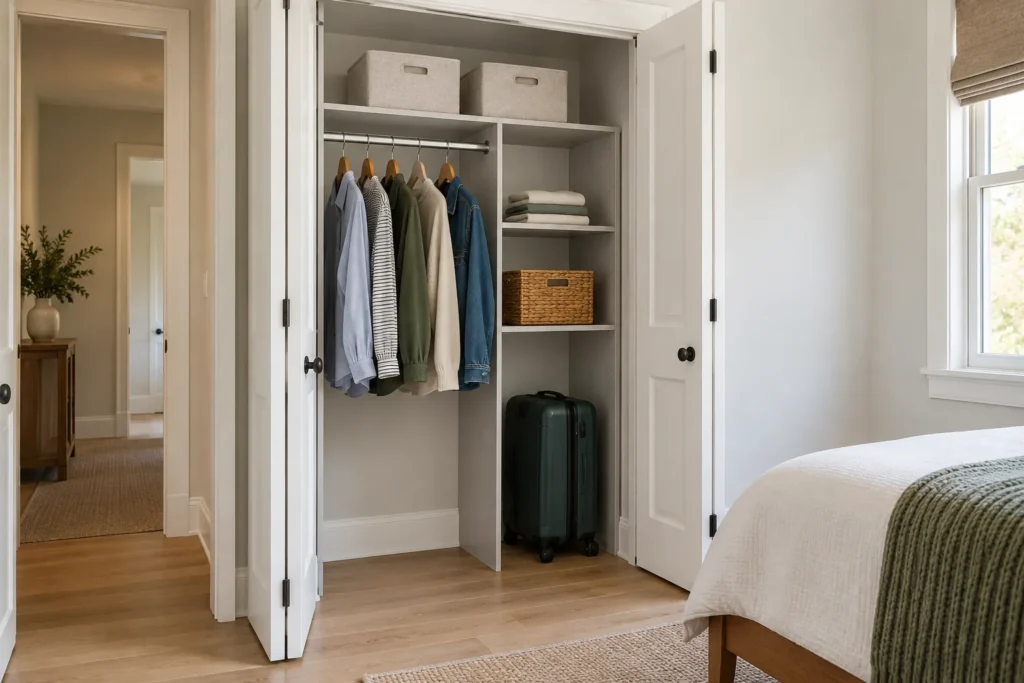
For an opening used from the bedroom, review reach-in closet planning before finalizing pull-outs or projecting accessories. Everyday hanging should be approachable through the part of the opening the doors actually leave clear.
Make the shoe collection easy to check
Put the full footwear collection together, including tall boots, larger shoes and seasonal pairs. Shelf spacing that suits low trainers may not accommodate boots. A small number of varied openings can serve a mixed collection better than many equally spaced narrow shelves.
Decide which pairs belong in the bedroom closet and which are better kept near the entrance. Recently worn wet boots should not be pushed beneath clean clothing. Locate everyday dry footwear where it can be retrieved without moving a bin or squeezing around a door.
Angled shoe shelves and pull-out racks are choices to test against shoe size and access. They use depth and hardware that may reduce other storage. Keep enough visibility to identify a pair without lifting the shelf above it. An open shelf is a reasonable choice when it supports that ordinary routine.
Keep a useful zone for changing contents
A guest closet may hold bedding between visits and luggage when someone stays. A child’s clothing may gradually need longer hanging. A shared closet can shift as a household’s routines change. Identify these likely transitions rather than fixing every centimetre around today’s exact contents.
An open lower bay can accommodate a suitcase or larger bag without requiring a special mechanism. Adjustable shelf spacing can adapt a folded category. Keep the permanent structure distinct from components intended to move, and confirm the adjustment range available in the proposal.
Flexibility does not mean leaving the whole closet undefined. Give daily items clear homes, then retain a small practical zone for less predictable needs. Labelled light bins help keep upper storage recognizable without converting every high shelf into a crowded holding area.
Confirm what stays and what changes
Check baskets and hampers against the routine
A hamper can keep laundry contained, provided it is easy to reach, remove and clean. Consider whether clothes are sorted in the closet or in the laundry room. Two compartments are helpful only if that separation continues through the household’s washing routine.
A basket on runners needs space to extend and enough clearance for its contents to come out. An open removable basket needs a shelf that allows it to lift freely. Both choices can become awkward behind a parked sliding door or a narrow side return. Review their operation with the opening visible.
Do not fill every remaining bay with a mechanism. Compare the value of the accessory with the hanging or shelf space it consumes, and ask about cleaning, adjustment and replacement. The best choice should make a repeated task easier.
Decide what stays in an existing closet
Selected component changes may suit a sound existing interior with useful hanging and shelving. Look for the specific problem: a missing drawer, inefficient shelf spacing or a shoe category without a clear place. Confirm the condition and dimensions of the retained parts before assuming new pieces can simply attach to them.
If rods, depth, drawer positions and access are all wrong, a fuller redesign may be the more coherent scope. Discuss removal, wall repair, trim and final finishing explicitly. An existing panel system can leave holes or reveal uneven walls when removed, and that preparation is a separate practical consideration from the new compartments.
Compare closet components for the main storage choices and hardware and accessories for the extras. A written proposal should identify what is retained, what is replaced and how the selected components will operate together.
Questions about planning your space
Can organizers be added to an existing closet?
Selected components may fit a sound existing layout, but the retained panels, wall conditions and opening need to be checked. A complete change may make more sense when several parts of the interior and its access are unsuitable.
Are all organizer shelves adjustable?
Some shelves can move within defined support positions; others are fixed structural parts. Ask which pieces can be adjusted and how the intended contents affect that arrangement.
Do I need drawers as well as shelves?
That depends on the inventory. Drawers contain loose or smaller items, while open shelves keep folded categories visible. Choose the mix from the items and retrieval routine rather than a standard package.
Where should less frequently used items go?
Suitable upper shelves can serve light seasonal contents in recognizable bins. Heavy or awkward pieces need a safe practical lifting position, even when they are only retrieved occasionally.
Will a pull-out hamper fit behind sliding doors?
Only when its position and travel align with a genuinely clear opening. The parked panel, track and handles all need to be considered, along with space to remove and clean the hamper.
Closet Organizers Gallery
Build an organizer around the daily routine
Tell us what belongs in the closet, what currently gets lost or crowded and whether the existing interior can stay. Notes about the opening, shelf depth and everyday contents help focus the design discussion on useful components, accessible locations and a clear scope.