
Advice & Planning · Burlington
Which Closet Accessories Are Worth Considering?
Choose an accessory because it solves a repeated storage task. Check the space it consumes, the way it opens and the simpler arrangement it replaces before adding it to the plan.

Choose an accessory for a recurring task
- Identify the item or routine the mechanism should improve.
- Include its occupied space, full movement and comfortable reach in the plan.
- Check removal, adjustment and care before prioritizing the useful additions.
In this guide10 sections
Start with the task that keeps repeating
List the small frustrations that happen during a normal week: jewellery mixed in a drawer, belts sliding off a shelf, tomorrow’s outfit resting on a door, or laundry left beside the wardrobe. Describe the action before choosing the hardware. An accessory should shorten that action or give an item a stable home. If you cannot name what it improves, leave it out of the initial plan and preserve the space for storage you already know you need.
Also note how often the task occurs and who performs it. A feature used twice each day deserves a more accessible position than one used before an occasional trip. Shared closets may need separate zones instead of a more elaborate mechanism. Review the basic hanging, shelf and drawer allocation first. Accessories work best as additions to a sound layout, rather than as a way to compensate for insufficient room or an awkward opening.
Count the space each mechanism occupies
A pull-out occupies a cabinet bay even when it is empty. Its frame, slides and required operating space may reduce the useful storage compared with a plain shelf or drawer. Ask for the intended component dimensions and the usable internal space, then compare that with the actual items. A attractive display does not establish that your folded sweaters, shoes or laundry bag will fit in the proposed part.
Check the space outside the cabinet too. A tray must pull through the door opening, a hamper needs room to move and a person needs a comfortable position to use either. The surrounding doors, adjacent drawers and furniture can all interrupt the sequence. Request a drawing showing the working position where necessary. Keep the simpler alternative visible in the comparison: sometimes an adjustable shelf or ordinary drawer resolves the same problem more economically in space.
Use trays where small items need separation
A shallow tray can prevent several categories of small belongings from mixing. Count the jewellery, watches, belts, ties or eyewear you actually keep together. Decide whether they need individual compartments, broader sections or a lined surface. The best division follows the contents, including items that are wider or longer than a display sample. A tightly compartmentalized tray can be less useful when the collection changes.
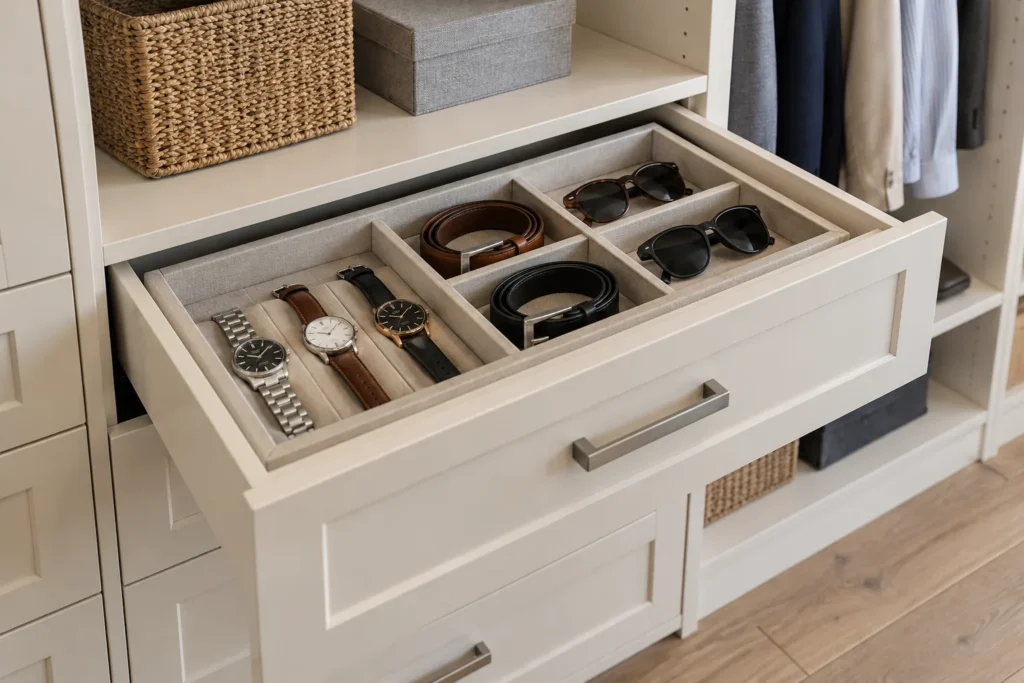
Check whether the insert can be removed for cleaning or reorganizing, and whether it fits the chosen drawer rather than merely resting across it. Leave enough access to see and retrieve items at the back. If only one drawer needs an insert, do not automatically duplicate it throughout the stack. Hardware and accessory choices should support the storage routine, with the actual configuration described in the proposal.
Consider a valet rod for a defined routine
A valet rod can provide a temporary position for an outfit being prepared, clothing waiting to be returned or a garment being checked. It is most useful when the person can approach it without stepping around a bed or blocking the closet entrance. Decide where the garment will hang when the rod is extended and whether nearby doors or drawers need to open at the same time. The temporary position still belongs in the circulation plan.
Ask about the particular rod’s intended use, fitting requirements and operating instructions. Do not treat it as extra permanent hanging capacity or assume a generic load rating. A pull-out rod should return easily to its stored position so it does not become an obstacle. If an ordinary hook or an open section of hanging rail fits the routine better, choose that simpler arrangement and reserve the accessory budget for a problem it solves more clearly.
Plan hampers around the route to the machines
A closet hamper can keep worn clothing from collecting on the floor, but its usefulness depends on what happens next. Consider whether the basket lifts out, whether it has a practical grip and how it passes through the closet and room doorway. Think about the person who carries it, the stairs or hall on the route and the place it will be set down. A fitted hamper that is awkward to empty creates another repeated task.
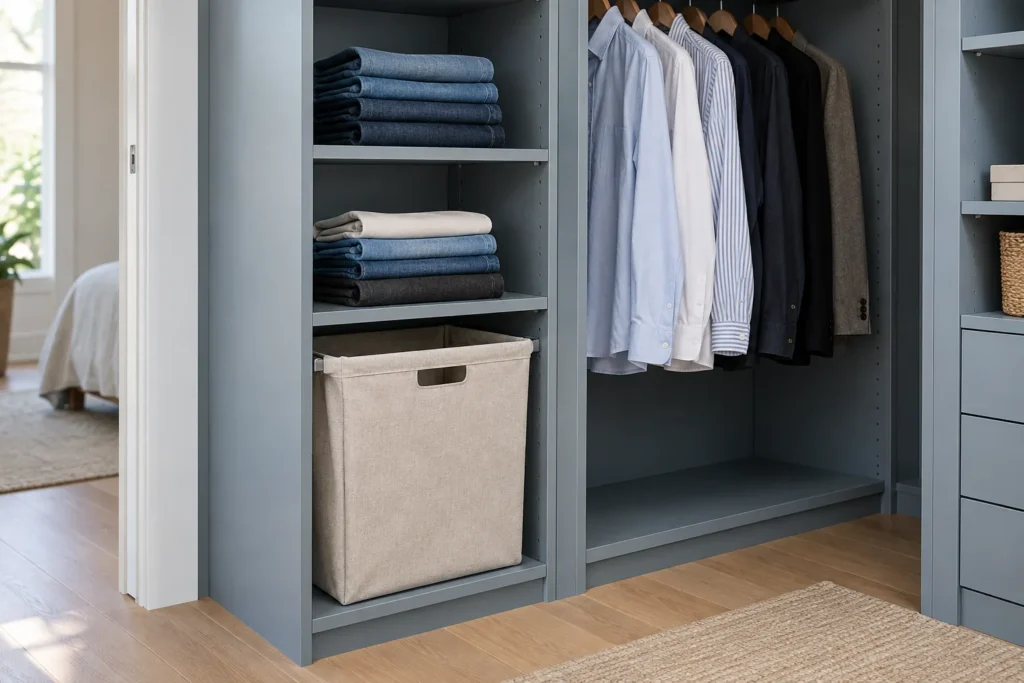
Separating categories can help if the household already sorts laundry before washing. If the routine is to carry everything together and sort beside the machines, multiple fitted compartments may consume space without adding value. Check ventilation and cleaning requirements for the specified component, and avoid treating an enclosed cabinet as a place to dry damp garments. A removable basket on a well-sized shelf may be the more adaptable choice.
Compare shoe inserts with plain shelves
Sort shoes by shape as well as number. Boots, runners, formal shoes and sandals use different heights and may be handled differently. An angled shelf or insert can improve visibility for some pairs, while a flat adjustable shelf offers simpler flexibility. Try the largest pair and the tallest boot in the proposed arrangement before counting how many shelves can be stacked. A neat display of identical shoes can conceal practical limitations.
A pull-out shoe component needs clear travel and a convenient position for retrieving pairs. Ask how footwear is retained and how the surface is cleaned. Avoid filling every slot merely because a mechanism offers them; leave room for changing seasons or a replacement pair. In a smaller closet organizer, straightforward shelves may preserve more usable space than several specialty racks with frames between them.
Test pull-outs through the actual opening
A pull-out can bring contents toward the user, which may help with a deep compartment. It also adds a moving part and an outward path. With sliding closet doors, confirm which opening is available when the panel is parked. With hinged fronts, check hinges, handles and the inner door edge. The component must clear the real opening throughout its movement, not just fit between the cabinet side panels.
Think about using one accessory while another storage zone is active. A hamper left extended may block shoe retrieval, and a broad tray can occupy the same standing space as a drawer below it. Design the likely sequence instead of testing everything independently. Storage components should be located around access and inventory; their symmetry on the drawing is less important than their useful operation.
Choose positions people can comfortably use
An accessory placed too high, too low or behind another object can be inconvenient even when the mechanism itself is good. Review the reach and grip of the people using the closet, including a child whose needs may change. Ask whether the proposed part has an easier alternative position. If access needs are specific, communicate them directly rather than expecting a standard display layout to suit everyone.
Keep frequent tasks in the easiest locations and occasional items in less prominent storage. In a walk-in closet, this may mean one carefully placed accessory bay instead of specialty hardware across every wall. Check that the person can stand in front of the feature while holding an item. A drawer that opens fully is only useful if its user also has enough room to approach and handle the contents.
Ask about adjustment, care and replacement
Accessories introduce product-specific details into the closet. Request the selected component description, available adjustment and cleaning guidance. Ask what happens if a basket, insert or moving part needs replacement later. Availability cannot be assumed from a photograph, and a similar-looking replacement may use different mounting dimensions. Keep the product information with the project documents so future maintenance is easier to identify.
Distinguish a removable insert from a fitted mechanism. One may be easy to lift out or change; the other can require compatible fixing positions and cabinet dimensions. Confirm any verified warranty terms for the actual item instead of assuming the cabinetry and every accessory have identical coverage. Where simplicity is a priority, choose fewer moving parts and preserve adjustment in the shelves around them.
Prioritize two or three changes that matter
Rank the proposed accessories by the daily task they improve, the storage they displace and how confidently they fit the room. Keep the highest-value features in the initial scope and identify optional items separately. That produces a clearer discussion than a long shopping list. Do a final review with real contents: place a garment on the planned temporary rod position, compare the hamper with the laundry route and check the tray against the collection.
Bring this shortlist to a design consultation, together with a basic wardrobe inventory. Mention a task that remains awkward even if you do not know its solution. The right answer may be a fitted accessory, a better drawer position or a simpler shelf. A useful closet is the arrangement that supports the routine after the novelty of the hardware has passed.