
How to Inventory Your Wardrobe Before Designing a Closet
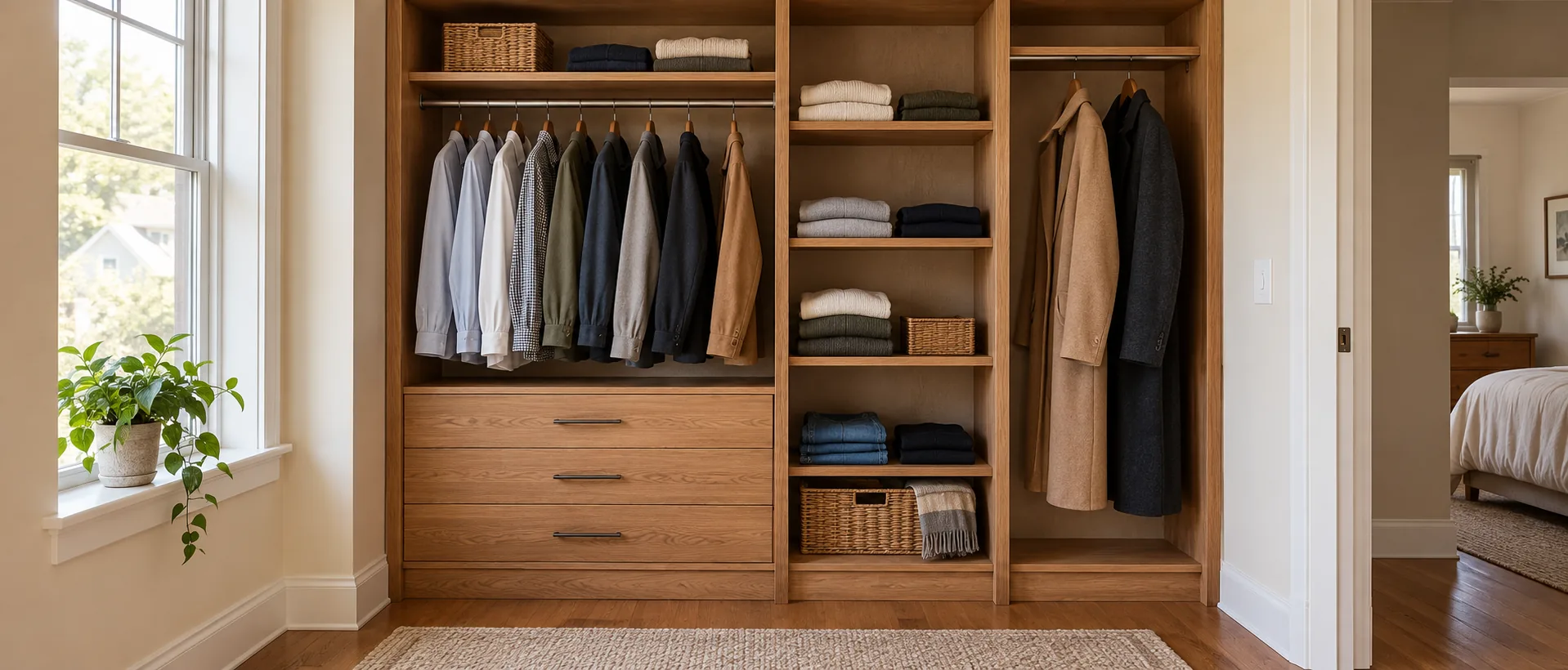
Turn the wardrobe into a planning brief
| Category | Record these details |
|---|---|
| Hanging clothes | Short and long garments, normal hangers and occupied rail width. |
| Folded clothes | Usable stack dimensions and the categories kept separately. |
| Shoes and bags | Pairs, varied heights, bag dimensions and awkward accessories. |
| Frequency | Daily, seasonal and occasional use, along with comfortable reach. |
In this article9 sections
An inventory is useful when it explains how your wardrobe needs to work, not merely how many things you own. Two people with the same number of garments may need very different closets: one hangs most clothing, while another folds knitwear and keeps many shoes. The design decision comes from the categories, dimensions and access habits behind the total.
Work through your current storage in manageable sections. A notebook or a simple table is enough. Separate daily items from seasonal and occasional belongings, note the categories that are difficult to use, and identify what is moving into or out of this closet. This approach gives a custom closet plan a practical brief without turning preparation into an exhausting household audit.
Decide which belongings belong in this closet
Before counting, define the boundary of the project. Include what will stay in the finished closet and what currently lives elsewhere but is expected to move into it. A bag collection in a spare room, winter coats in a hall and shoes by the entrance may change the storage requirement if they will all return to the bedroom. Write those decisions down rather than treating the current closet contents as the complete inventory.
Separate any belongings that are leaving. Keep a small list of undecided items instead of allowing them to disappear from the numbers. A proposed layout can then be discussed with an honest range: the definite wardrobe and the categories still under review. Do not assume every item will be discarded just because the existing shelves are full.
For a shared room, start with one column per person. Add a separate column for household items such as spare bedding. That prevents a large shared duvet from being mistaken for one person’s folded clothing and makes later discussions about equal or different storage allocations more concrete.
Count hanging garments by their actual length
Divide hanging clothes into groups that behave differently: shirts and short jackets, trousers hung in their usual way, long dresses, coats and any other taller pieces. Count garments on the hangers you intend to keep. Different hanger shapes and bulky shoulders change how densely a rail can be used, so a count of empty slim hangers is a poor substitute for the real collection.
Measure representative garments from the top of the hanger to the lowest point of the clothing. Include the longest item in each group rather than relying on an average. Note whether trousers are folded over a hanger or hung full length. The relevant dimension is the stored form, not the garment’s length when laid flat on a bed.
Then measure the occupied rail length of each group while clothing hangs comfortably. Avoid pushing everything tightly together to produce an optimistic number. You should be able to separate garments and remove one without dragging the neighbouring pieces along. The hanging-space guide explains how those observations inform the arrangement.
Record folded clothing in usable stacks
Fold a typical selection the way you actually maintain it. Measure the width and depth of the stack, and note a practical stack height you can use without repeatedly rebuilding it. A tall tower may fit inside a cupboard but still be frustrating when the bottom item is needed. Count how many separate stacks the category requires at a manageable height.
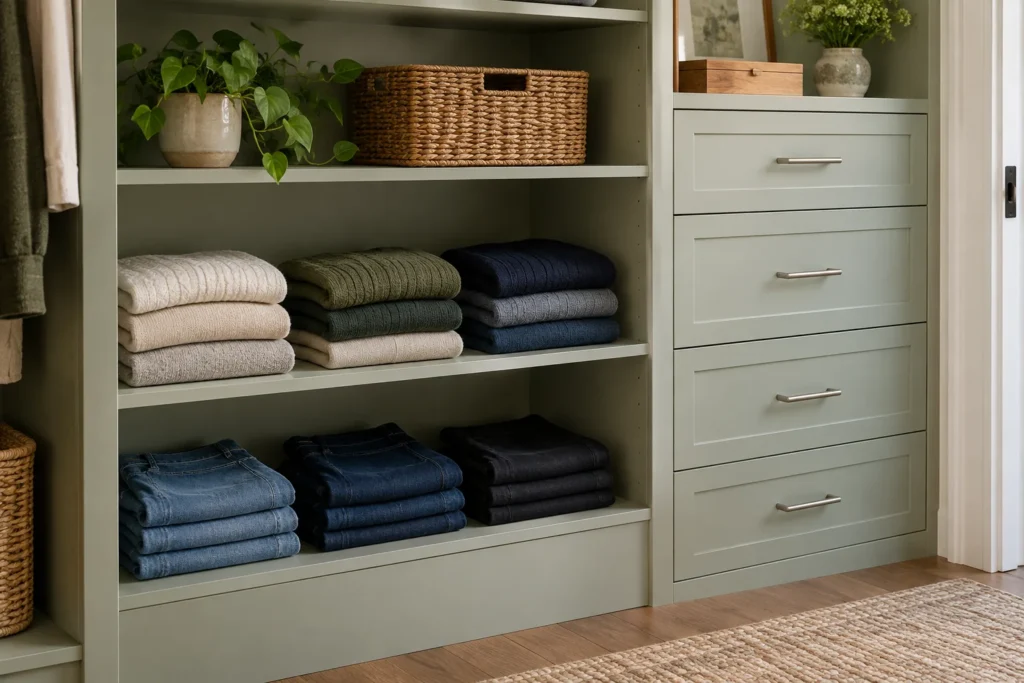
Distinguish clothing that benefits from a shelf from small items that are easier in a drawer. Jumpers, jeans and larger folded tops may form stable stacks; socks, undergarments and small accessories often become scattered on open shelving. The inventory should record the routine you prefer rather than reproduce the limitations of the current furniture.
Write down any sorting method that matters. You may separate work clothing, exercise wear and weekend items, or share a shelf with a partner. A divider can help maintain those groups, but it also consumes space. Bring the real folded dimensions into the conversation before choosing a uniformly divided shelf elevation.
Count shoes as pairs with different heights
Separate everyday shoes, boots, taller boots and occasional footwear. Count pairs, then check the dimensions of the largest ordinary pair in each group. A shelf arrangement that suits low shoes may not accommodate ankle boots without adjustment. Storing footwear in boxes introduces a different inventory, so note which boxes are staying and measure them as stored objects.
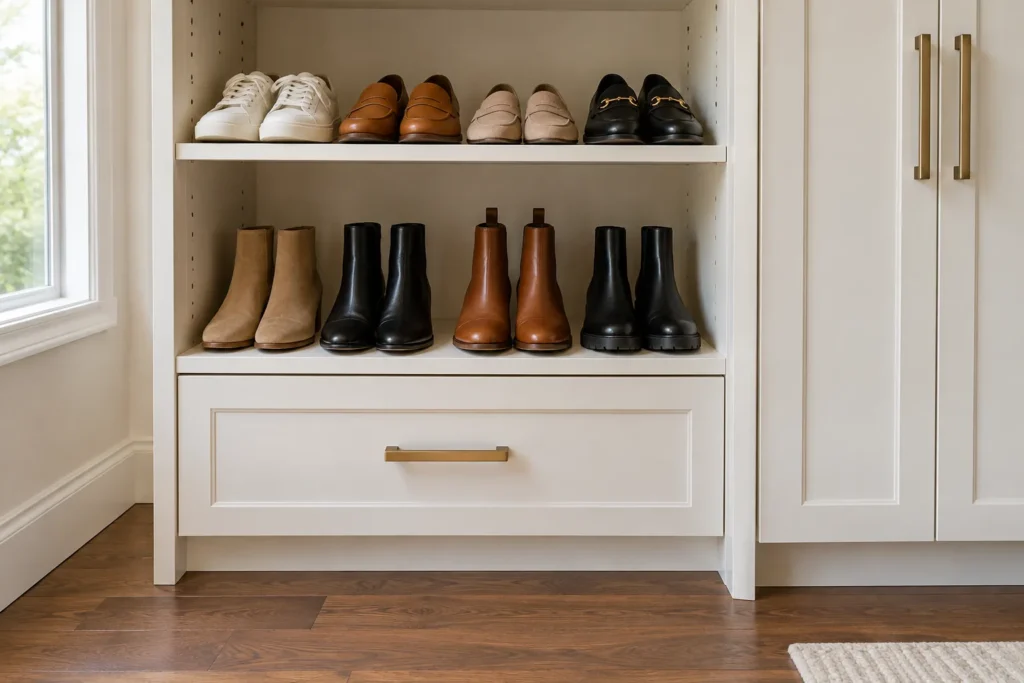
Consider how you retrieve and return each pair. One visible row is easier to understand than a deep shelf with shoes behind shoes. If reserve footwear will sit higher or in a secondary area, record that decision explicitly. Daily shoes should not be counted as occasional items merely to make the most convenient zone look less crowded.
Include seasonal changes in the notes. Burlington households may move wet outdoor footwear through an entrance area before it reaches a bedroom closet. The clothing closet should be planned for its intended contents, while drying and dirty footwear routines belong in a suitable separate location. Do not assume a wardrobe shelf solves every shoe-related household problem.
Measure bags and awkward accessories separately
Bags, hats, belts and scarves often occupy more usable space than their item counts suggest. Record the largest structured bag, the way softer bags are stored and whether straps hang or lie inside a compartment. A narrow shelf can look suitable in a drawing yet bend or crush an item that was never measured.
Group small accessories by the method that keeps them usable. Belts might be rolled in a drawer or hung individually; scarves may be folded, draped or contained in a box. Choose a routine you can maintain before selecting a specialized fitting. An accessory that holds a category neatly in a photograph is only useful if you will return the items that way each day.
Do not provide an inventory of valuables or private possessions that is unnecessary to the design. You can describe a small-item drawer or a closed personal compartment without listing its contents. The components resource helps compare general storage functions while keeping the conversation focused on size, access and organization.
Give seasonal and occasional items an honest allowance
Separate current-season daily items from clothing used occasionally or at another time of year. Record where the off-season collection will live. If it remains in this closet, it still needs a defined location even when it is not on the easiest rail. If it moves to another room, check that the alternative location is a real part of the household plan.
Measure the containers you intend to use for reserve clothing. Include their handles, lids and the space needed to lift them out. A shelf that fits a container’s base may not provide comfortable removal under the next shelf. Heavier or awkward objects should not automatically be assigned to a high position simply because they are used less often.
Allow for foreseeable changes without inventing an arbitrary expansion percentage. A growing child, a change in work routine or a regular sports activity can be described specifically. That is more useful than adding unused compartments everywhere. Keep the definite inventory, seasonal reserve and future considerations as distinct notes so trade-offs remain visible.
Map frequency and reach alongside the counts
Mark categories as daily, weekly or occasional, then identify which person uses each group. This is a simple way to separate storage capacity from convenient access. A closet may hold every item while putting the daily shoes behind a door overlap or placing frequently worn knitwear above a comfortable reach.
Note any reach or movement preference that should shape the arrangement. You may prefer drawers because bending into a deep lower cupboard is awkward, or want a clearly separated rail for each person. Describe the task rather than assigning a generic “accessible” label to the room. Different users and different routines require specific discussion.
Try the current closet with one ordinary item from each daily category. Observe where you stand, which door must move and whether another item has to be removed first. Add that information to the inventory. It helps decide whether the problem needs more storage, a different component, or simply a better position within the existing opening.
Turn the notes into priorities and a compact brief
Arrange your findings in a table with category, count, stored dimensions, frequency and preferred method. It does not need to be beautifully formatted. A row for long hanging, one for short hanging, several folded categories and separate footwear groups will communicate far more than a single overall garment total.
Choose three priorities from the findings. Examples might be keeping all long coats clear of the lower shelf, seeing everyday shoes in one row, or giving each person a drawer area. Identify one or two flexible categories as well. Perhaps reserve bags can move to upper storage, while daily shirts must remain easy to reach. Those distinctions make a proposal easier to evaluate.
Use the hanging, shelving, drawers and shoes guide to compare functions against the inventory. Do not select every available organizer in advance. Start with what each category needs, then discuss which combination supports it in the actual room and opening.
Check the inventory against the room before committing
Keep the inventory separate from the room measurements until both can be considered together. A useful quantity of double hanging may fit the garment collection but conflict with a side return or door access. A wider drawer bank may suit folded clothing while leaving too little reachable hanging space. The list explains requirements; it does not prove a particular cabinet layout fits.
Record the current categories and the access problem in a short written brief. Include any existing furniture whose storage will be replaced or retained. That allows the conversation to account for the whole wardrobe rather than treating the closet and dresser as unrelated projects.
Bring the compact brief to a design consultation and keep the unresolved decisions visible. The useful outcome is a layout that reflects the belongings you actually use, with clear trade-offs between capacity, reach and movement. A thoughtful inventory supports that decision without requiring a perfect count of every small item in the household.