
Hardware & Accessories · Burlington
Useful hardware starts with the way the closet is used
Choose fittings that make the closet easier to open, reach and reset. Handles, trays, valet rods and hampers are most useful when they answer a specific daily task.
Evaluate handles as a grip and an opening detail
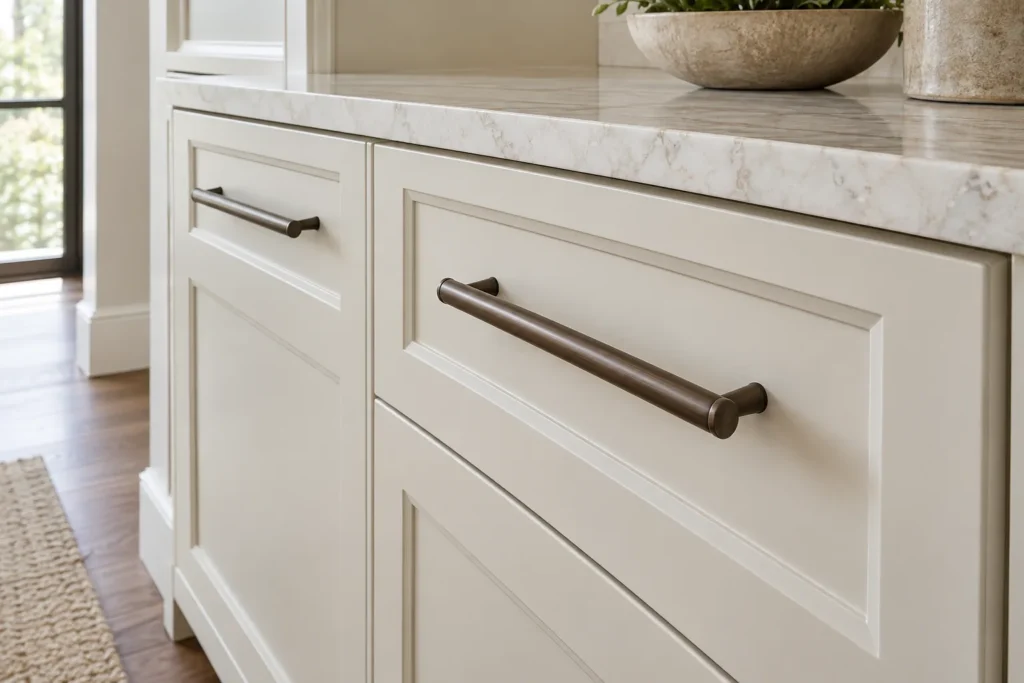
A handle is touched repeatedly, so its shape matters as much as its appearance. Consider the grip space behind a pull, the effort needed to open the front and whether the size feels comfortable to the people using it. A tiny knob can look restrained but may not suit every hand or a heavier drawer.
Projection affects nearby movement. Handles can meet an adjacent wall, another door or a passing garment when the front opens. Review their location with hinge movement and fillers. Long pulls also establish a visual rhythm across a run, so placement should correspond to the actual front arrangement rather than be selected independently at the end.
Handle-free fronts still need an opening method. Recessed grips, edge pulls and push mechanisms each change how a person approaches the cabinet and how the front is detailed. Ask to understand the operation, including what happens when hands are full. The easiest-looking elevation is not always the easiest daily action.
Check the fitting against the ordinary task
Match drawer and door hardware to the contents
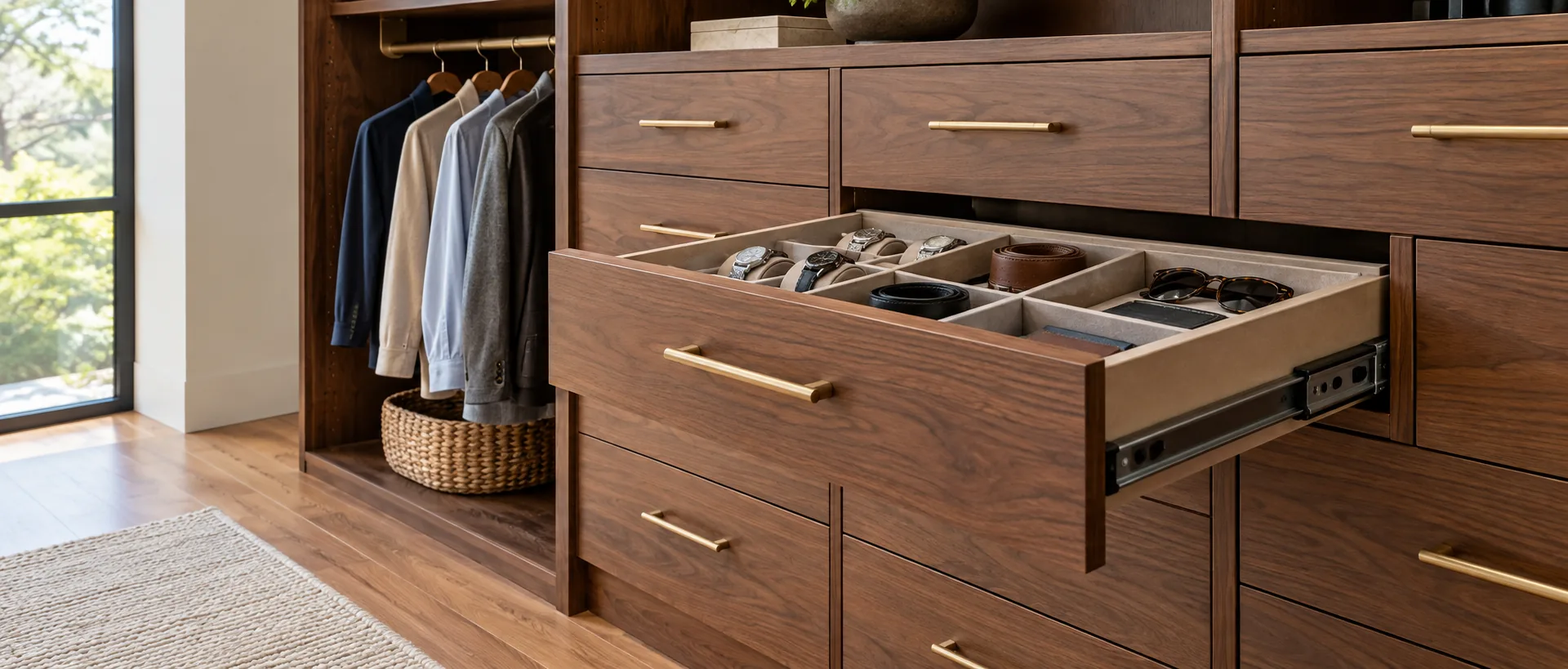
Drawer hardware determines how far the contents come forward and how the drawer closes. Discuss the intended contents, drawer size and the chosen runner arrangement together. A tray of small accessories and a drawer of bulky sweaters create different requirements. Do not infer capacity or load suitability from the size of the front.
Detailed checks
Soft closing is a behaviour, not a complete specification. It does not remove the need for correct alignment, usable access or maintenance. Hinges also affect the clear opening behind a door. Internal drawers must travel past the open front and hardware, with enough space to avoid catching on them.
Ask what adjustment and care are expected after regular use. Keep cleaning guidance tied to the selected hardware and finish. Avoid forcing a stiff mechanism or adding an unapproved lubricant as a default fix; the particular fitting’s instructions and the installation arrangement should guide the response.
Use dividers to separate categories you actually own
A shallow tray can make jewellery, watches, belts or eyewear easier to see. Begin with the objects and their sizes. Compartments that are too narrow, too deep or too specific can become awkward when the collection changes. A removable divider arrangement may offer a useful balance between order and flexibility.
Detailed checks
Check the tray’s relationship to the drawer. The usable interior is smaller than the outer front, and a stacked insert may hide contents underneath. Think about whether the item can be lifted out easily and whether the lining can be cleaned. Soft materials also need to suit the intended belongings, rather than being chosen only for the photograph.
For broad decisions about hanging, shelves and drawers, return to closet components. Hardware improves the chosen compartment; it should not be expected to repair an interior plan that gives important categories too little space.
Compare shoe fittings with a plain shelf
A shoe pull-out can make a deep compartment easier to reach, but it adds a mechanism and a more specific arrangement. Confirm that the collection fits: boots, larger shoes and varied heel shapes may not suit the same rack. A plain adjustable shelf can sometimes handle the changing mix with less complexity.
Detailed checks
Test the open position on the proposed layout. The fitting may project into a route or sit behind an opening that is too narrow for convenient operation. In a shared closet, consider how one person uses it while someone else accesses hanging or drawers nearby.
Keep optional fittings in a priority order. Choose the few that remove a real repeated frustration, then review what they displace and what maintenance they introduce. A short list of well-positioned accessories can be more useful than a crowded interior full of moving parts.
Ask how an accessory can be replaced if the household’s needs change. A fitting installed inside a broadly useful compartment may preserve more flexibility than a highly specific custom opening. Confirm compatible replacement options and the space left behind if the mechanism is removed; avoid assuming all future accessories will share the same dimensions.
Consider shared use as well. One person may favour a divided tray while another needs a clear shallow drawer. The hardware schedule should reflect those different categories instead of repeating the same insert merely to make the open interior look consistent.
Give a valet rod a clear temporary task
A valet rod can hold an outfit while dressing, receiving laundry or preparing for the next day. Its usefulness depends on location. It needs a comfortable reach, a real fixing position and enough room for the hanger and garment when extended. It should return neatly when the task is finished.
Place it away from drawer travel and door swing. A temporary hanging position in the middle of a narrow aisle may disrupt the entire closet. Check where the garment falls as well as where the rod begins; it should not land against a handle, shelf edge or another hanging category.
Treat it as temporary staging rather than extra permanent hanging. If it is always full, the main inventory allocation may need more space. A simple rod earns its place when it supports a repeatable short task without becoming another place where clothes accumulate.

Consider the complete hamper route
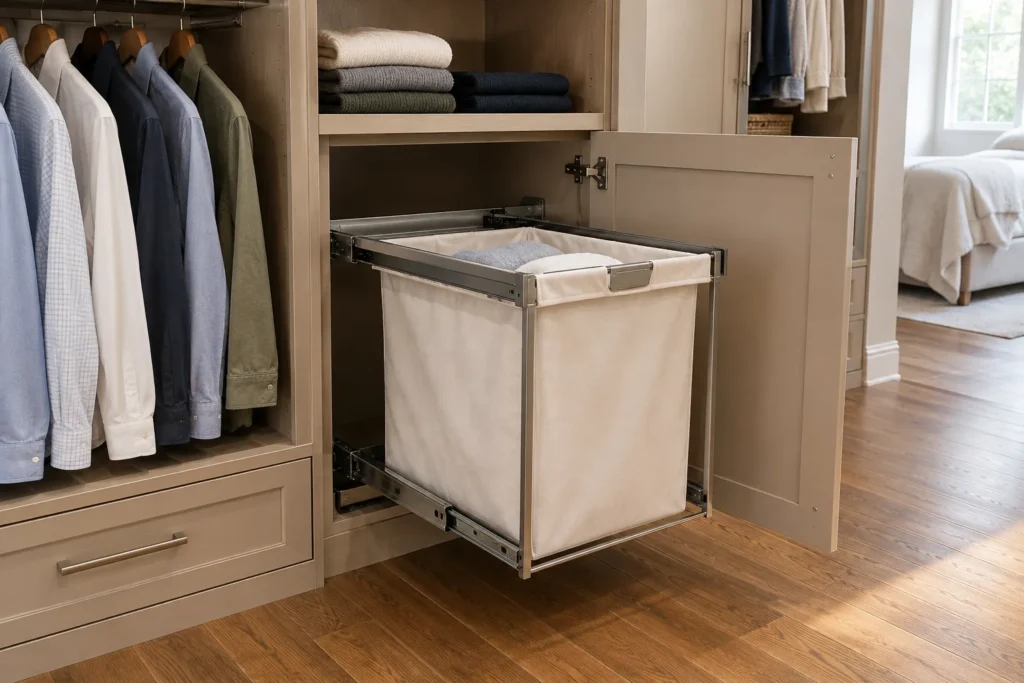
A concealed hamper can keep laundry in a defined location. Check how clothes are added, how the container comes out and where it goes next. A removable basket that cannot pass the door opening, or a full container that is awkward to lift, can make a tidy-looking fitting inconvenient.
A pull-out needs room in front and proper support for the specified use. Its open position should not block another drawer or become a surprise obstruction in the aisle. Consider whether two smaller removable containers would work better than one large deep unit, particularly when laundry is sorted before it leaves the room.
Discuss ventilation and cleaning in relation to the selected cabinet and container. Damp items need an appropriate household routine; hiding them behind a front does not solve that problem. The fitting should be easy to empty, clean and reset without rearranging the surrounding closet.
Questions about planning your space
Does soft closing mean the drawer has more capacity?
No. Closing behaviour and usable capacity are different decisions. The drawer size, contents and specified runner arrangement need to be considered together.
Can a valet rod replace a hanging compartment?
It is better treated as temporary staging for dressing or laundry. If it stays full, the main hanging allocation should be reviewed. The extended rod and garment need a clear location.
Are accessory trays worthwhile for every drawer?
Only where the categories benefit from separation. Measure the objects and consider future changes. A tray should make items easier to retrieve without creating unsuitable compartments or hiding a lower layer.
What should I ask about a pull-out hamper?
Ask how the container is removed, how it passes the opening and where the pull-out sits when extended. Discuss cleaning, the laundry route and the fitting’s specified use.
Identify the actions that feel awkward today
Tell us which doors are hard to grip, which small items disappear and how laundry or outfit preparation moves through the closet. Share the opening and the current interior. A hardware discussion can then focus on fittings that improve those specific actions.